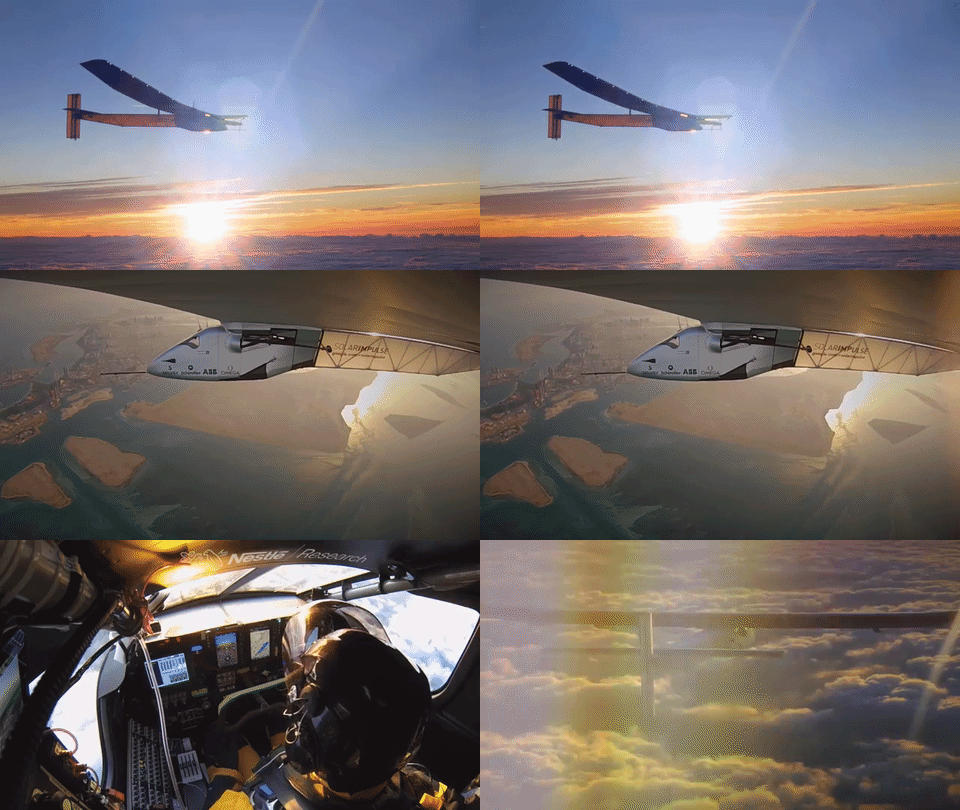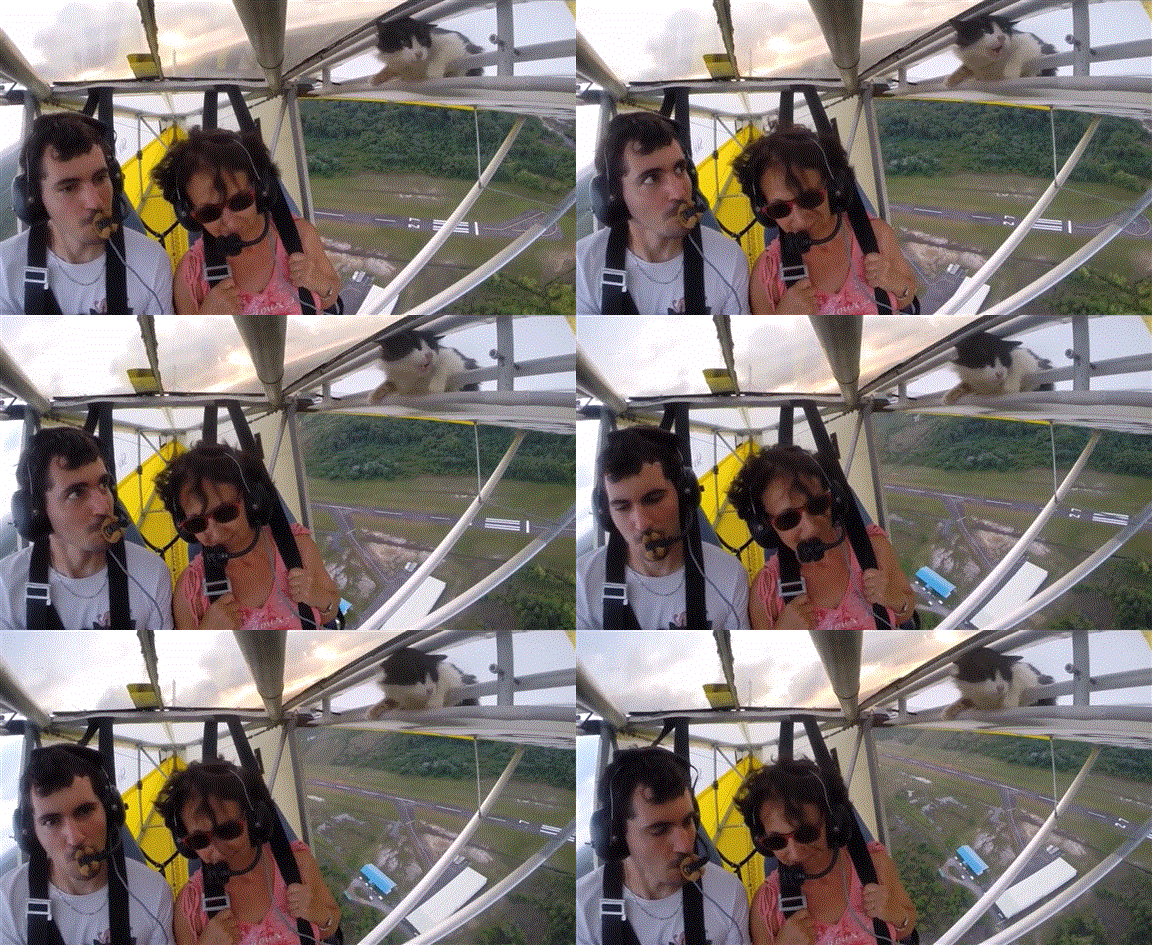
Its Past-
The development of heavier-than-air flight in the half century between Sir George Cayley's coachman in 1853 and the Wright brothersmainly involved gliders. However, the sport of gliding only emerged after the First World War, as a result of theTreaty of Versailles, which imposed severe restrictions on the manufacture and use of single-seat powered aircraft in Germany's Weimar Republic. Thus, in the 1920s and 1930s, while aviators and aircraft makers in the rest of the world were working to improve the performance of powered aircraft, the Germans were designing, developing and flying ever more efficient gliders and discovering ways of using the natural forces in the atmosphere to make them fly farther and faster. With the active support of the German government, there were 50,000 glider pilots by 1937. The first German gliding competition was held at the Wasserkuppe in 1920 organized by Oskar Ursinus. The best flight lasted two minutes and set a world distance record of 2 kilometres (1.2 mi). Within ten years, it had become an international event in which the achieved durations and distances had increased greatly. In the 1936 Summer Olympics in Berlin gliding was a demonstration sport, and it was scheduled to be a full Olympic sport in the 1940 Games. A glider, the Olympia, was developed in Germany for the event, but World War II intervened. By 1939 the major gliding records were held by Russians, including a distance record of 748 kilometres (465 mi). During the war, the sport of gliding in Europe was largely suspended, though several German fighter aces in the conflict, including Erich Hartmann, began their flight training in gliders.
In many countries during the 1950s a large number of trained pilots wanted to continue flying. Many were also aeronautical engineers who could design, build and maintain gliders. They started both clubs and manufacturers, many of which still exist. This stimulated the development of both gliding and gliders, for example the membership of the Soaring Society of America increased from 1,000 to 16,000 by 1980. The increased numbers of pilots, greater knowledge and improving technology helped set new records, for example the pre-war altitude record was doubled by 1950, and the first 1,000-kilometre (620 mi) flight was achieved in 1964. New materials such as glass fiber and carbon fiber, advances in wing shapes and airfoils, electronic instruments, the Global Positioning System and improved weather forecasting have since allowed many pilots to make flights that were once extraordinary. Today over 550 pilots have made flights over 1,000 kilometres (620 mi). Although there is no Olympic competition, there are the World Gliding Championships. The first event was held at the Samedan in 1948. Since World War II it has been held every two years. There are now six classes open to both sexes, plus three classes for women and two junior classes. The latest worldwide statistics for 2011 indicate that Germany, the sport's birthplace, is still a center of the gliding world: it accounted for 27 percent of the world's glider pilots, and the three major glider manufacturers are still based there. However the meteorological conditions that allow soaring are common and the sport has been taken up in many countries. At the last count there were over 111,000 active civilian glider pilots and 32,920 gliders,plus an unknown number of military cadets and aircraft. Clubs actively seek new members by giving trial flights, which are also a useful source of revenue for them.
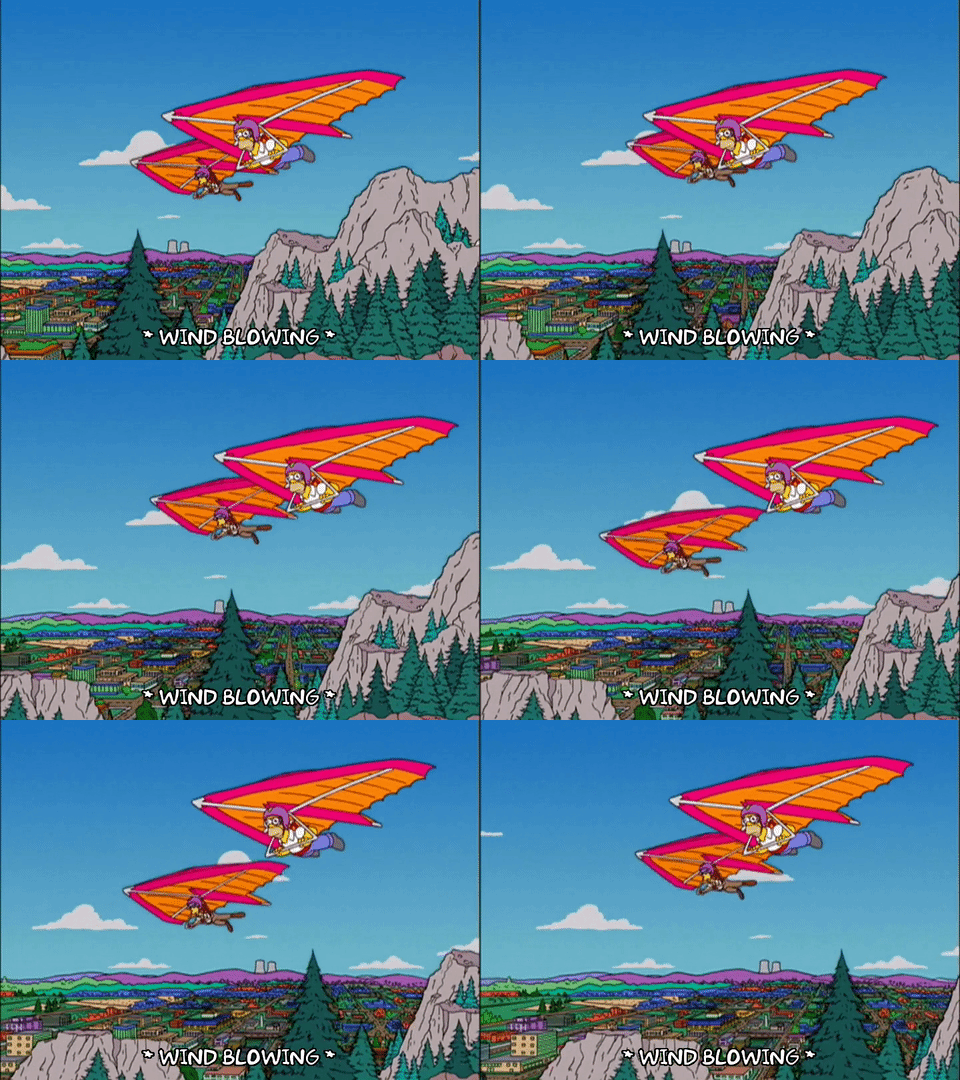
Thermals-
Thermals are streams of rising air that are formed on the ground through the warming of the surface by sunlight. If the air contains enough moisture, the water will condense from the rising air and form cumulus clouds. When the air has little moisture or when an inversion stops the warm air from rising high enough for the moisture to condense, thermals do not create cumulus clouds. Without clouds or dust devils to mark the thermals, thermals are not always associated with any feature on the ground. The pilot must then use both skill and luck to find them using a sensitive vertical speed indicator called a variometer that quickly indicates climbs and descents. Occasionally reliable thermals can be found in the exhaust gases from power stations or from fires.
Once a thermal is encountered, the pilot can fly in tight circles to keep the glider within the thermal, so gaining altitude before flying towards the destination or to the next thermal. This is known as "thermalling". Alternatively, glider pilots on cross-country flights may choose to 'dolphin'. This is when the pilot merely slows down in rising air, and then speeds up again in the non-rising air, thus following an undulating flight path. Dolphining allows the pilot to minimize the loss of height over great distances without spending time turning. Climb rates depend on conditions, but rates of several meters per second are common and can be maximized by gliders equipped with flaps. Thermals can also be formed in a line usually because of the wind or the terrain, creating cloud streets. These can allow the pilot to fly straight while climbing in continuous lift.
Cross Country-
One of the measures of a glider's performance is the distance that it can fly for each meter it descends, known as its glide ratio. Depending on the class, this can range in modern designs from 44:1 in the Standard Class up to 70:1 for the largest aircraft. A good gliding performance combined with regular sources of rising air enables modern gliders to fly long distances at high speeds. The weather is a major factor in determining cross-country speeds. The record average speed for 1,000 kilometres (620 mi) is 203.1 kilometres per hour (126.2 mph). required unusually good conditions, but even in places with less favorable conditions (such as Northern Europe) a skilled pilot could expect to complete flights over 500 kilometres (310 mi) every year.
As the performance of gliders improved in the 1960s, the concept of flying as far away as possible became unpopular with the crews who had to retrieve the gliders. Pilots now usually plan to fly around a course (called a task) via turn-points, returning to the starting point.
In addition to just trying to fly further, glider pilots also race each other in competitions. The winner is the fastest, or, if the weather conditions are poor, the furthest round the course. Tasks of up to 1,000 km have been set and average speeds of 120 km/h are not unusual.
Initially, ground observers confirmed that pilots had rounded the turn-points. Later, the glider pilots photographed these places and submitted the film for verification. Today, gliders carry secure GNSS Flight Recorders that record the position every few seconds from GPS satellites. These recording devices now provide the proof that the turn-points have been reached.
National competitions generally last one week, with international championships running over two. The winner is the pilot who has amassed the greatest number of points over all the contest days. However, these competitions have as yet failed to draw much interest outside the gliding community for several reasons. Because it would be unsafe for many gliders to cross a start line at the same time, pilots can choose their own start time. Furthermore, gliders are not visible to the spectators for long periods during each day's contest and the scoring is complex, so traditional gliding competitions are difficult to televise. In an attempt to widen the sport's appeal, a new format, the Grand Prix, has been introduced. Innovations introduced in the Grand Prix format include simultaneous starts for a small number of gliders, cockpit mounted cameras, telemetry giving the positions of the gliders, tasks consisting of multiple circuits, and simplified scoring.
There is a decentralized Internet-based competition called the Online Contest, in which pilots upload their GPS data files and are automatically scored based on distance flown. Worldwide, 6,703 pilots registered for this contest in 2010.
Maximizing average speed-
Soaring pioneer Paul MacCready is usually credited with developing mathematical principles for optimizing the speed at which to fly when cross-country soaring, although it was first described by Wolfgang Späte in 1938. The speed to fly theory allows the optimal cruising speed between thermals to be computed, using thermal strength, glider performance and other variables. It accounts for the fact that if a pilot flies faster between thermals, the next thermal is reached sooner. However at higher speeds the glider also sinks faster, requiring the pilot to spend more time circling to regain the altitude. The MacCready speed represents the optimal trade-off between cruising and circling. Most competition pilots use MacCready theory to optimize their average speeds, and have the calculations programmed in their flight computers, or use a "McCready ring", a rotatable bezel on the glider's variometer to indicate the best speed to fly. The greatest factor in maximizing average speed, however, remains the ability of the pilot to find the strongest lift.
On cross-country flights on days when strong lift is forecast, pilots fly with water ballast stored in tanks or bags in the wings and fin. The fin tank is used to reduce trim drag by optimizing the center of gravity, which typically would shift forward if water is stored only in the wings ahead of the spar. Ballast enables a sailplane to attain its best L/D at higher speeds but slows its climb rate in thermals, in part because a sailplane with a heavier wing loading cannot circle within a thermal as tightly as one with a lower, unballasted wing loading. But if lift is strong, typically either from thermals or wave, the disadvantage of slower climbs is outweighed by the higher cruising speeds between lift areas. Thus, the pilot can improve the average speed over a course by several percent or achieve longer distances in a given time. If lift is weaker than expected, or if an off-field landing is imminent, the pilot can jettison the water ballast by opening the dump valves.
On days with particularly strong and widespread lift pilots can attain high average speeds by alternating periods of fast flight with pull-ups, merely slowing down in areas of lift without deviating from the course. This 'dolphining' technique can result in high average speeds because the height lost can be minimised until particularly strong lift is encountered when circling would be most effective.


Badges-
Achievements in gliding have been marked by the awarding of badges since the 1920s. For the lower badges, such as the first solo flight, national gliding federations set their own criteria. Typically, a bronze badge shows preparation for cross-country flight, including precise landings and witnessed soaring flights. Higher badges follow the standards set down by the Gliding Commission of the Fédération Aéronautique Internationale (FAI).
The FAI's Sporting Code defines the rules for observers and recording devices to validate the claims for badges that are defined by kilometers of distance and meters of altitude gained. The Silver-C badge was introduced in 1930. Earning the Silver Badge shows that a glider pilot has achieved an altitude gain of at least 1,000 metres (3,281 ft), made a five-hour duration flight, and has flown cross-country for a straight-line distance of at least 50 kilometres (31 mi): these three attainments are usually, but not invariably, achieved in separate flights. The Gold and Diamond Badges require pilots to fly higher and further. A pilot who has completed the three parts of the Diamond Badge has flown 300 kilometres (186 mi) to a pre-defined goal, has flown 500 kilometres (311 mi) in one flight (but not necessarily to a pre-defined goal) and gained 5,000 metres (16,000 ft) in height. The FAI also issues a diploma for a flight of 1,000 kilometres (621 mi) and further diplomas for increments of 250 kilometres (155 mi).
If lift is not found during a cross-country flight, for example because of deteriorating weather, the pilot must choose a location to "land out". Although inconvenient and often mistaken for "emergency landings", landing out (or "outlanding") is a routine event in cross-country gliding. The pilot has to choose a location where the glider can be landed safely, without damaging the plane, the pilot, or property such as crops or livestock. The glider and the pilot(s) can then be retrieved by road from the outlanding location using a purpose-built trailer. In some instances, a tow-plane can be summoned to re-launch the aircraft.
Training & Regulation-
In addition to national laws controlling aviation, the sport in many countries is regulated though national gliding associations and then through local gliding clubs. Much of the regulation concerns safety and training.
Many clubs provide training for new pilots. The student flies with an instructor in a two-seat glider fitted with dual controls. The instructor performs the first launches and landings, typically from the back seat, but otherwise the student manages the controls until the student is deemed to have the skill and the airmanship necessary to fly solo. Simulators are also beginning to be used in training, especially during poor weather.
After the first solo flights glider pilots are required to stay within gliding range of their home airfield. In addition to solo flying, further flights are made with an instructor until the student is capable of taking a glider cross-country and of handling more difficult weather. Cross-country flights are allowed when they have sufficient experience to find sources of lift away from their home airfield, to navigate, and to select and land in a field if necessary. In most countries pilots must take a written examination on the regulations, navigation, use of the radio, weather, principles of flight and human factors. Proposals are being made to standardise the training requirements across European countries.
In addition to the regulation of pilots, gliders are inspected annually and after exceeding predetermined flight times. Maximum and minimum payloads are also defined for each glider. Because most gliders are designed to the same specifications of safety, the upper weight limit for a pilot, after allowing for a parachute, is usually 103 kilograms (227 lb). There is also a limit, 193 centimetres (6 ft 4 in), on the tallest pilots who can safely fit into a typical glider's cockpit